YouTruck Active iPhone, iPad, NodeJS
Early AR magazine experience for YouTruck — point the camera at a print page and stream video onto the recognized image, plus a MEAN admin for editors.
YouTruck · iOS · AR · NodeJS
- YouTruck
- 2014
- Lead Architect / Developer
YouTruck Active was created for YouTruck, a Greek magazine for trucks, commercial vehicles and professional drivers. The original idea was simple: allow readers to point their phone at selected pages of the printed magazine and reveal additional digital content, primarily video.
What started as an AR feature quickly became a much larger engineering project. I designed and built the native iOS application, backend services, editorial administration platform, media delivery infrastructure and AR content pipeline, while also exposing the API consumed by a separately developed Android client.
This was around 2014. There was no ARKit or ARCore, React Native had not yet been released, Flutter did not exist, and many of the abstractions available to mobile developers today simply weren’t there. Solving some of the more unusual requirements meant working considerably further down the stack.
What I built
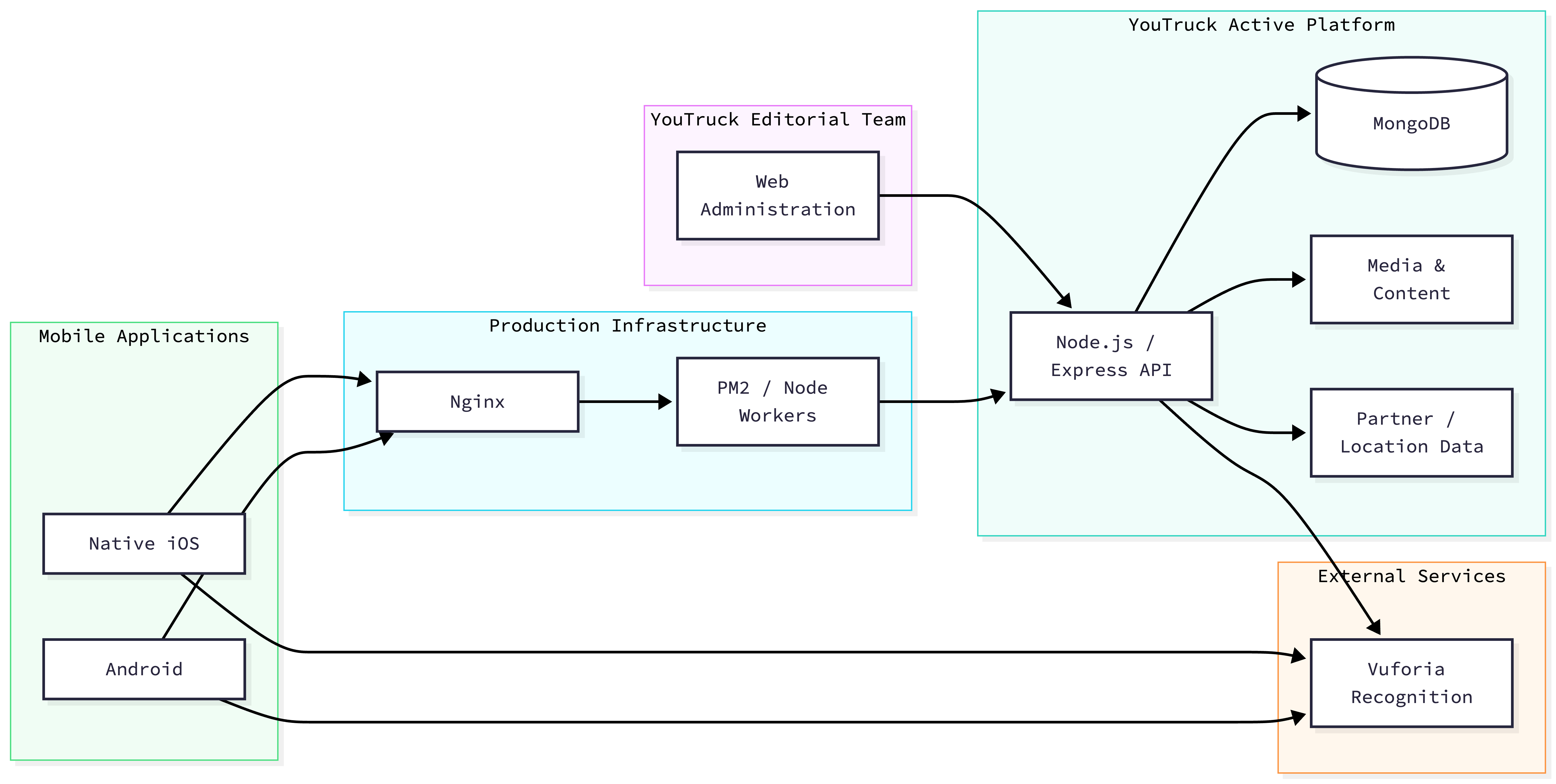
The final platform consisted of several interconnected systems:
- a native iOS application using Vuforia, Objective-C++, AVFoundation and OpenGL
- a MEAN-based administration platform for YouTruck’s editorial team
- a Node.js / Express REST API
- MongoDB for application and content metadata
- integration with Vuforia’s image-recognition services
- a media-delivery layer for remotely hosted images and videos
- geolocation services for approximately 700 partner locations
- driver-focused functionality including nearby services and a panic feature
- API documentation supporting both the iOS and Android applications
- production infrastructure using Linux, Nginx, PM2 and TeamCity
The important part was that this wasn’t an AR demo with a few hard-coded magazine pages. It was a system that allowed the client to continuously publish and manage interactive content.
The product idea
The interaction we wanted was deliberately simple.
A reader would see an interactive page in the physical magazine, open YouTruck Active and point the camera at it. The application would recognise the printed image and display the corresponding video directly over the page, following its position and perspective as the user moved the phone.
The editorial team, however, needed to control all of this without developer involvement.
I therefore built an administration application where editors could upload a magazine image, attach its corresponding video and manage the content exposed to the mobile applications. The backend submitted image targets to Vuforia, tracked their asynchronous processing state and stored the relationship between recognition targets and YouTruck content.
Rather than placing video URLs directly inside Vuforia’s metadata, I stored an internal content identifier. When the application recognised a page, that identifier was resolved through my own API.
That kept image recognition independent from content delivery. Videos could be replaced, moved or served differently without recreating the recognition target or releasing a new version of the application.
The hardest technical problem: remote AR video
The most technically challenging part was something that initially sounded like a minor detail. Vuforia provided an iOS video-playback example, but it was designed around video files stored locally on the device.
YouTruck’s videos were remote and could be several minutes long. Bundling them inside the application was not realistic, and downloading an entire video before displaying it would have made the experience impractical.
The requirement was therefore: **stream a remote video while rendering its decoded frames onto an OpenGL surface attached to a recognised physical image.**There was no straightforward native Vuforia solution for this at the time. Vuforia could provide the transformation describing where the magazine page existed in the camera view. AVFoundation could stream and decode the video. The missing part was connecting those two systems.
Using AVPlayerItemVideoOutput, I accessed the pixel buffer of the currently decoded remote video frame. Those frames were then passed into the OpenGL rendering pipeline and used as the texture rendered on the surface positioned by Vuforia.
The runtime pipeline effectively became:

The iOS application therefore crossed several layers of the stack: native UIKit code, Objective-C++, Vuforia’s native SDK, AVFoundation’s media pipeline and OpenGL rendering. It was considerably deeper than simply integrating an augmented-reality SDK. I later documented the technique in Vuforia SDK + remote video streaming on iOS. The solution addressed a problem other developers were encountering as well, and the article was eventually stickied in Vuforia’s developer forums.
That was one of the technical achievements from the project that I remain particularly proud of: the requirement took me beyond the capabilities of the SDK examples, and the resulting solution became useful outside the original product.
Beyond augmented reality
AR was the feature that initially defined YouTruck Active, but it eventually became only one capability of the application.
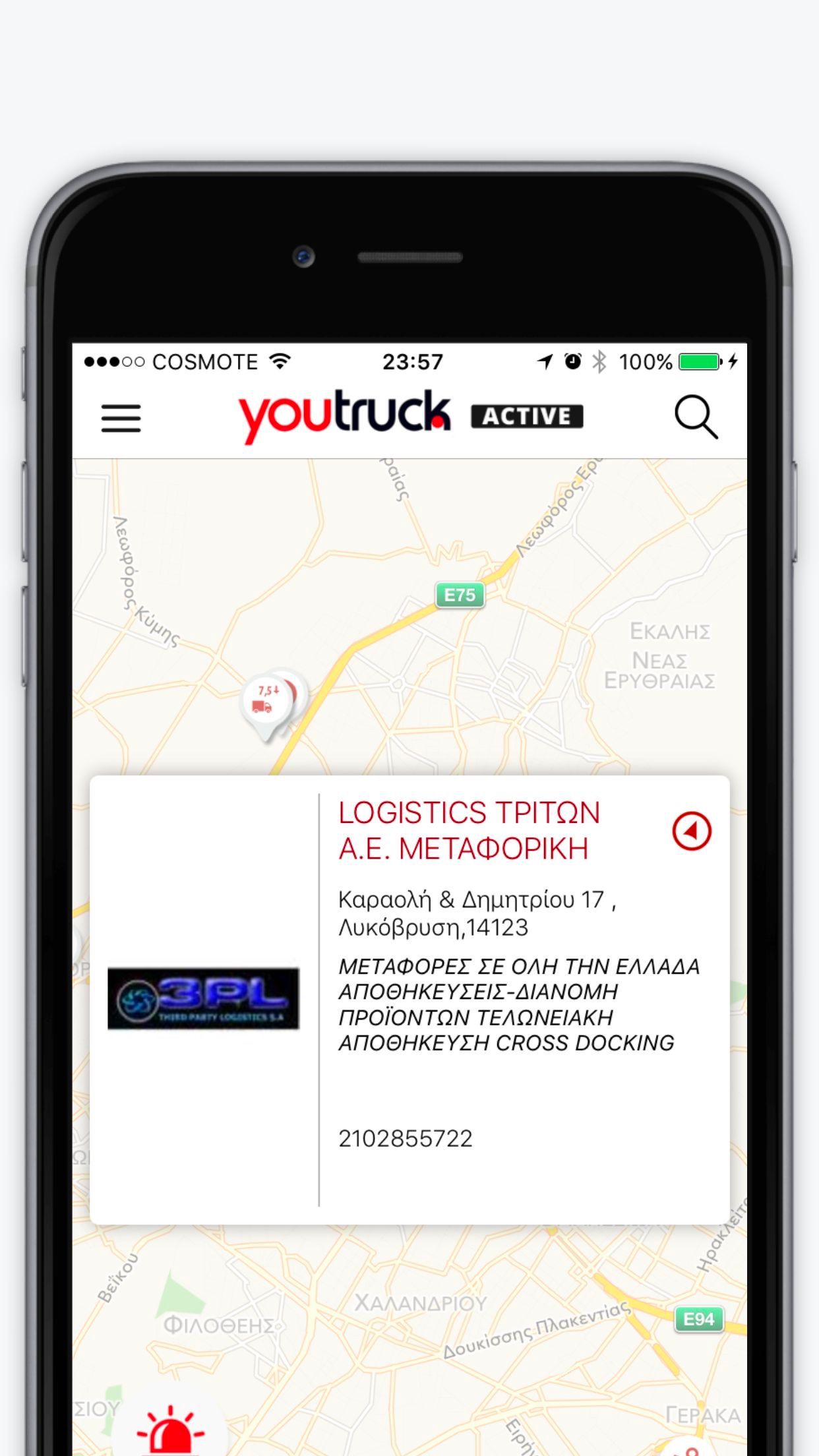
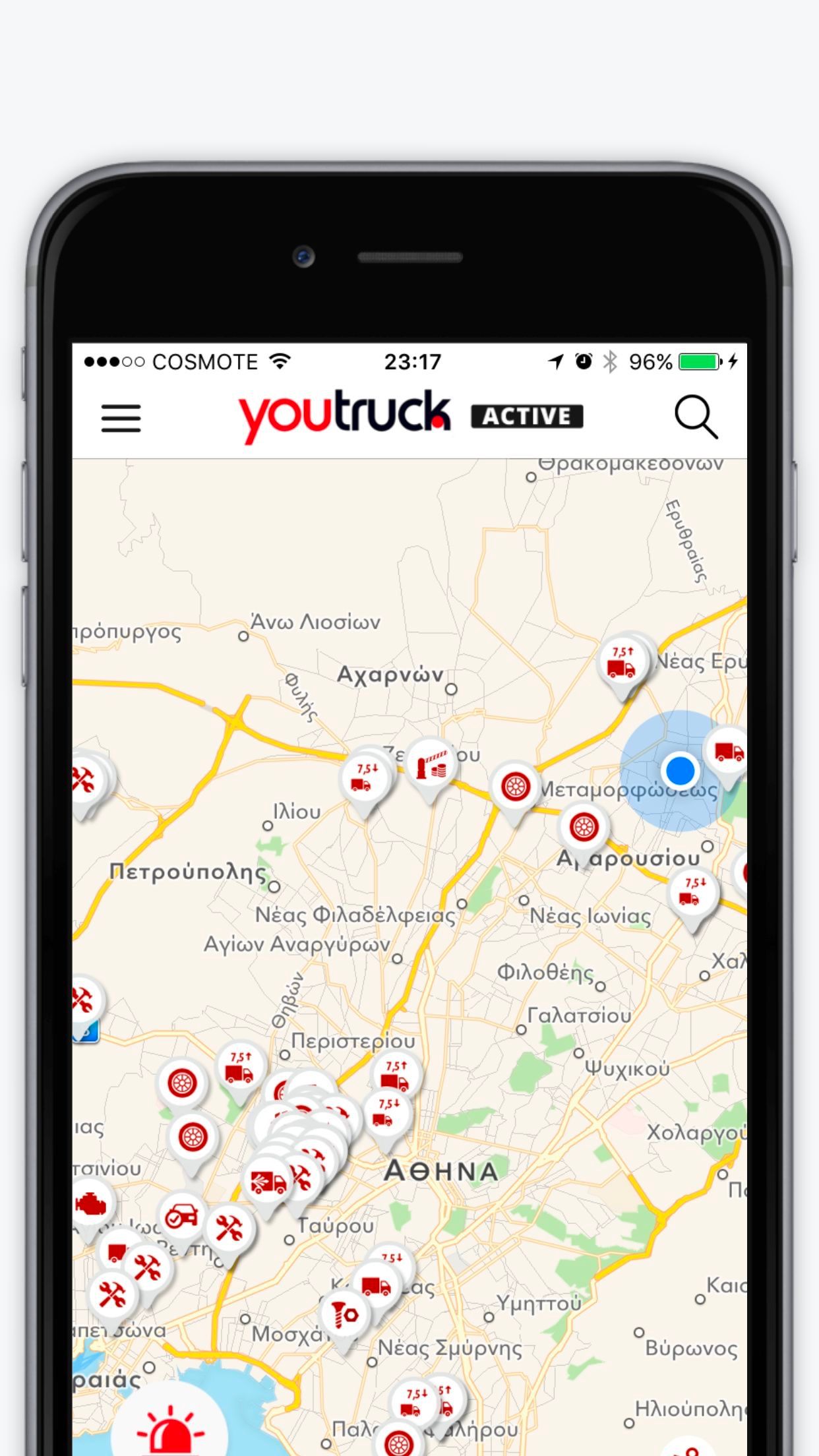
YouTruck maintained a network of roughly 700 businesses relevant to professional drivers, including tyre shops, repair facilities and other commercial-vehicle services. I extended the platform so the editorial team could maintain these businesses, their location, information and photographs. The mobile applications could then use the driver’s location to surface useful services nearby.
Additional functionality followed, including location-aware features, loyalty-related capabilities and a panic function aimed at drivers on the road.
The backend was consequently supporting two related products at once: an interactive publishing platform around the physical magazine and a location-aware companion application for professional drivers.
API and backend architecture
An Android client was being developed separately, so I treated the REST API as an independent product boundary rather than an internal implementation detail of the iOS application. The API was documented using Apiary and provided a common interface for AR content, media metadata, locations and the application’s other services. On the server side, the platform ran on Linux with Node.js, Express and MongoDB. Nginx handled incoming traffic and static media delivery, while PM2 managed the Node.js processes.
This separation was particularly useful for video and image assets. Large media files could be delivered directly through Nginx rather than unnecessarily passing through the Node.js application layer.
The deployment process was later automated through TeamCity, providing a basic CI/CD pipeline from source control to the production server.

None of that infrastructure was visible to the reader holding the magazine. The reader simply pointed a phone at a page and saw a video appear. That simplicity depended on quite a lot happening underneath it.
Why this project still matters to me
Looking at YouTruck Active today, almost every layer could be implemented differently.
Modern mobile platforms provide native AR capabilities. Cross-platform frameworks are mature. Video delivery is routinely handled by managed object storage and CDNs. Cloud databases, hosted services and modern CI/CD tooling eliminate much of the infrastructure that had to be assembled manually.
That wasn’t the landscape when this project was built.
When an SDK stopped at the boundary of what you needed, there was often no framework underneath waiting to solve the next problem. You had to understand the lower-level APIs and connect the pieces yourself. YouTruck Active required me to move between product design, frontend development, backend architecture, API design, native iOS, Objective-C++, media processing, OpenGL rendering, image recognition, geolocation and Linux infrastructure.
That breadth wasn’t designed into the project for its own sake. It emerged naturally from the problem. What began as “can we make a magazine page play a video?” became a complete content and mobile platform, with its own editorial tooling, APIs, infrastructure, AR rendering pipeline and services for professional drivers.
That is what makes it one of the projects I still consider a significant technical achievement.
Features and technologies
- Augmented Reality (Vuforia)
- GeoLocation
- MEAN Stack: Mongo, Express, Angular (1.5)
- iOS UIKit
- OpenGL for streamed video → texture rendering
Links