Use case
C.E.L.L. (Vodafone Greece)
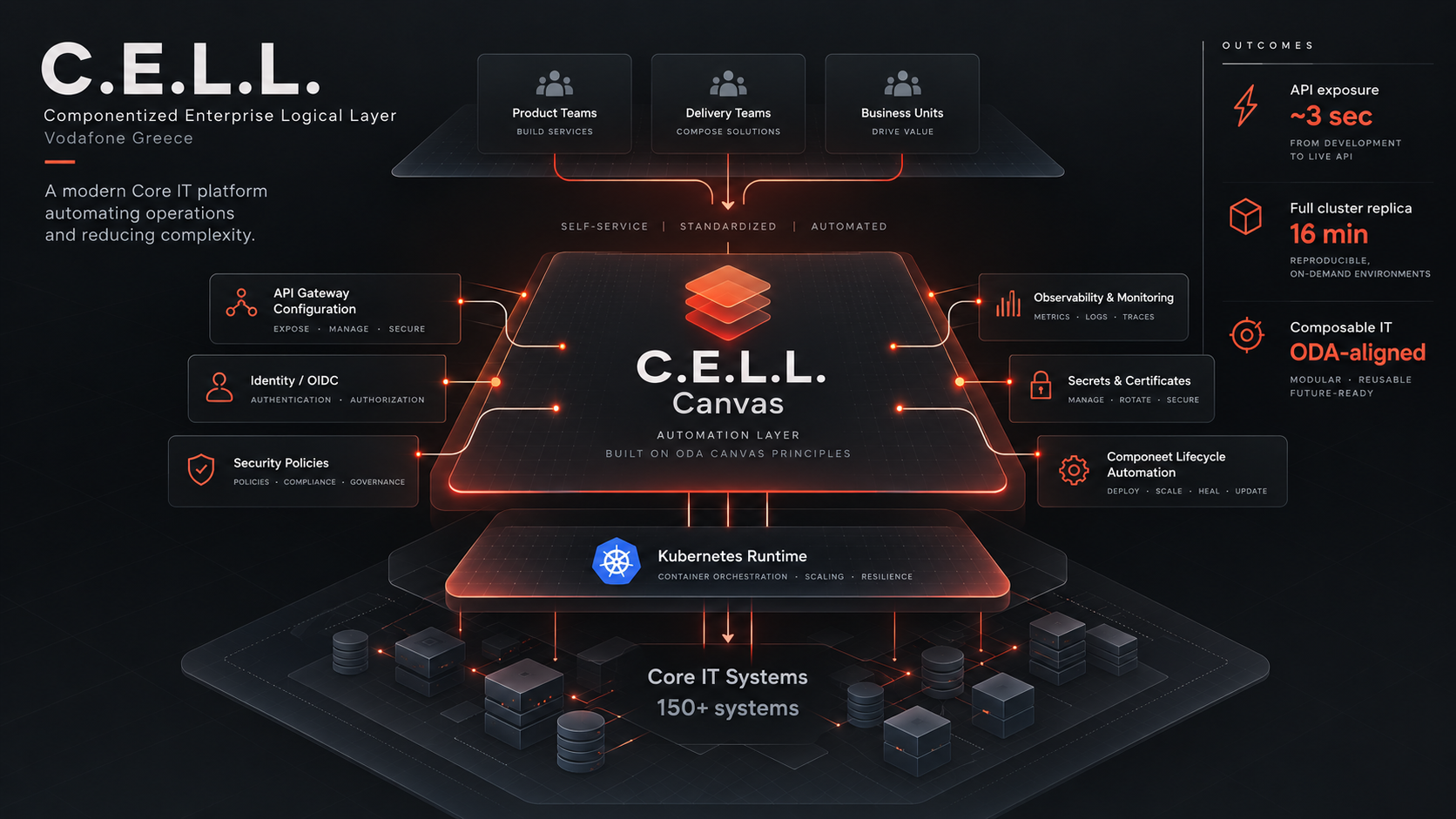
CELL brought a product-oriented, declarative delivery model to Vodafone Greece’s Core IT—making API exposure and environment setup part of the platform rather than a sequence of hand-offs.
Vodafone Greece · Platform Engineering · Kubernetes · TM Forum ODA
- Company
- Vodafone Greece
- Period
- 2022–2025
- Role
- Lead Architect / Developer
Documented impact
150+
Core IT systems in scope
Up to 2 weeks → ~3 seconds
API exposure, reported by Vodafone Tech
~16 minutes
Full-cluster replica flow
Problem
Vodafone Greece’s Core IT landscape includes more than 150 systems. As digital delivery grew, releasing a capability meant coordinating application, gateway, identity, and environment work across separate hand-offs. The lessons from DXL’s shared digital platform made the next problem clear: Core IT needed a delivery platform that gave teams more independence and made operational intent repeatable.
Design
CELL—Componentized Enterprise Logical Layer—is a Kubernetes-based platform aligned with TM Forum Open Digital Architecture (ODA). It packages services as CELL/ODA components, with Helm and an ODA component manifest describing API exposure, authentication, and events.
Its Canvas operators reconcile that declared intent into gateway routes and identity configuration. Terraform establishes foundations; Argo CD delivers applications; Apache APISIX and Keycloak provide edge and identity capabilities. Quarkus services and Java operators implement the application and control-plane pieces.
Automation in practice
Vodafone’s engineering account reports that manually exposing an API could take up to two weeks. With CELL Canvas reconciling component definitions, the same exposure takes about three seconds. The same declarative model enables a full cluster replica—including applications and gateway exposure—in about 16 minutes. See CELL: Reimagining IT Infrastructure for the engineering detail.
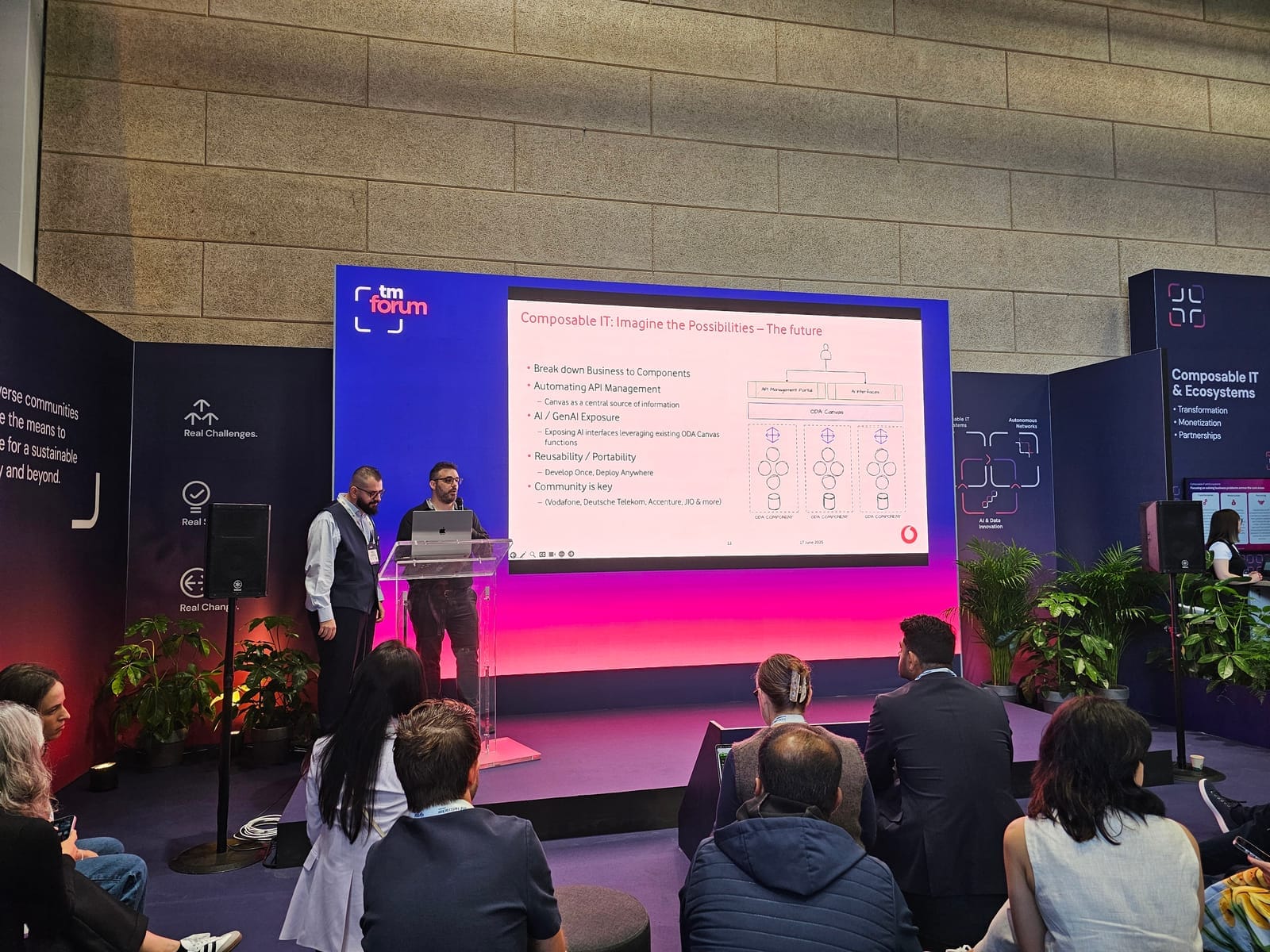
The composable-IT perspective I later shared is a reflection on why this matters: operators make platform knowledge executable, so teams can declare outcomes instead of repeating operational procedures.
Outcomes
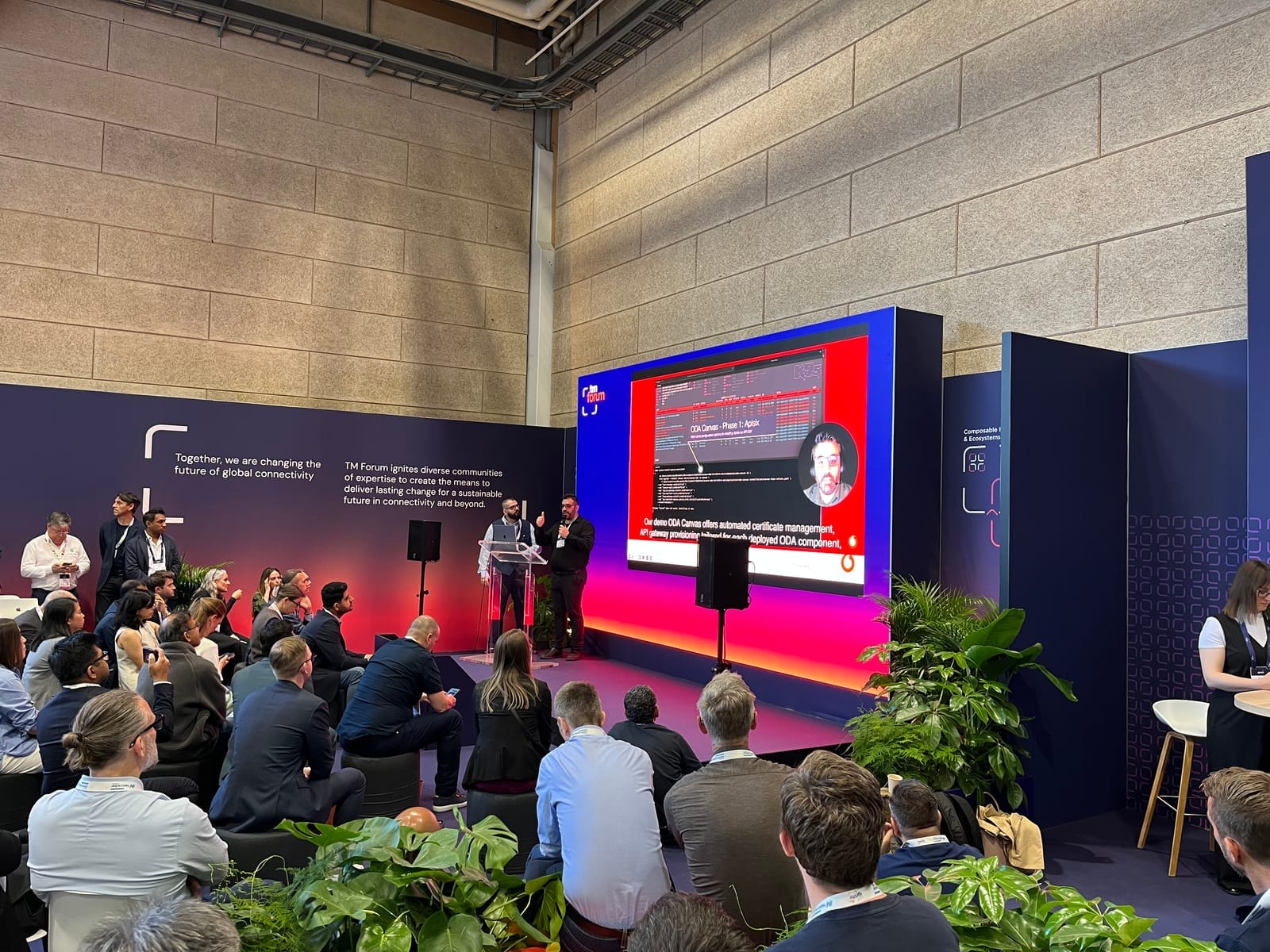
The published results are a shorter API-exposure path and a reproducible environment flow. The platform also gave Core IT a consistent component model for modular delivery, while TM Forum featured Vodafone Greece’s ODA Canvas automation story.
My contribution
I helped design the CELL team, architecture, and implementation: the component model, the Kubernetes operator approach, and the platform workflow that connects application declarations to gateway and identity state. I also presented the work publicly at the Athens Kubernetes Meetup and DTW Ignite.
Media & further reading
Athens Kubernetes Meetup Vol 22
Watch Athens Kubernetes Meetup Vol 22 on YouTube
The resource cards below link to the Vodafone engineering publications, DTW Ignite, TM Forum interview, and the composable-IT reflection.